Koos Kok hides and transports Mpayipheli
Heart of the HunterKoos Kok hides and transports Thobela Mpayipheli when the fugitive’s motorcycle and route make him vulnerable to capture. A travelling Griqua musician, Koos turns recognition into a plan: he conceals Mpayipheli and the BMW R 1150 GS in his battered Chevrolet El Camino, carries them past an encounter with police, and helps Mpayipheli get back on the road. His aid is not simply a pause in the pursuit. It changes the practical conditions of escape, and gives Mpayipheli an occasion to act with deliberation rather than surrender to instinct.
A chance encounter becomes assistance
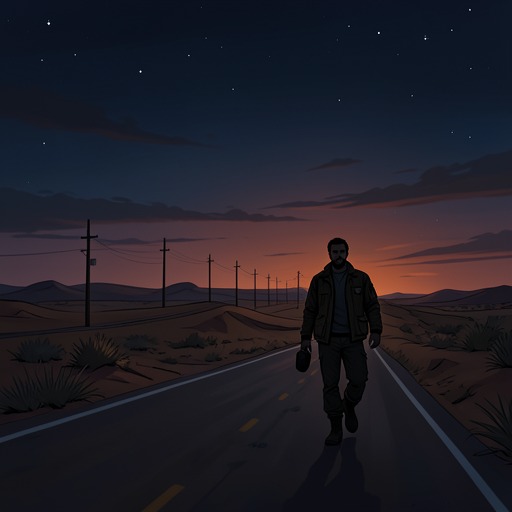
Mpayipheli reaches a neglected homestead in the Karoo after the pursuit has left him exhausted, injured, and forced off the fast route. The ruined house offers temporary shelter: its windows are patched with cardboard, its furnishings are sparse and dusty, and the motorcycle can be kept out of sight from the road. After hearing a car arrive, Mpayipheli takes cover, still alert to danger. Koos calls out that he is alone and a friend, asking Mpayipheli not to shoot. The encounter begins in suspicion, but not in a firefight.
Koos has already heard news reports about the fugitive biker and later listened to a radio discussion. When he sees the motorcycle behind his winter quarters, he recognizes it. He interprets the coincidence as divine guidance and decides he will not stand by. That decision is particularly consequential because Koos knows that helping Mpayipheli means involving himself in a national manhunt, not merely offering a stranger a meal or a place to rest.
Koos Kok and his improvised plan
Koos presents himself as a Griqua troubadour, a guitar player and entertainer who performs for town audiences and writes songs during the winter. His self-description arrives in a mixture of dialect and Afrikaans that Mpayipheli cannot follow; Koos switches into more widely understood language to tell his story, then slips back into his own speech and has to translate again. The conversation establishes Koos as talkative, comic, and proud of his identity, but his loquacity does not make his offer empty. He has heard the reports, identified the motorcycle, and is prepared to help.
The two eat bread and tinned pilchards in chilli-tomato sauce and drink cheap brandy from enamel mugs. Only after this interval of food and conversation does Koos disclose that he has a plan. Its strength is practical rather than elaborate: Mpayipheli and the motorcycle can travel hidden in the back of the van. Koos’s battered vehicle, normally associated with his itinerant life and work, becomes cover for a fugitive and his conspicuous machine.
Concealment on the road
Mpayipheli lies on an old mattress in the crowded rear of the El Camino, beside the BMW lying on its side. Koos has removed the bike’s baggage cases; the load also includes a carton of stolen mutton, battered furniture, and four worn suitcases filled with clothes and documents. A paint-spattered canvas tarp hides the jumble. With the van’s shock absorbers gone, the dirt road jolts the cramped space, while rain taps and drips through holes in the covering. The disguise is makeshift, uncomfortable, and dependent on the ordinary clutter of Koos’s life rather than any purpose-built concealment.
The journey is slow enough to strain Mpayipheli’s injured shoulder and cramped legs. He repeatedly thinks the van has arrived when Koos is only turning onto another road. When Koos finally lifts the tarp, Mpayipheli is blinded by the midday sun and sees grassland, hills, and the distant town of Philipstown: the landscape has shifted away from the Karoo. Koos has carried him and the motorcycle north, using the van to bridge a stretch of road that Mpayipheli could not safely ride.
A police encounter and a return to the motorcycle
During the journey, police stop Koos’s van. Their exchange suggests that they have noticed the concealed rider and motorcycle, but they do not detain Mpayipheli. Koos protests that the man with the motorcycle cannot ride in the back all the way; an officer tells him to leave before he gets into trouble. Koos obeys, then pulls away with the tyres spinning, saying he will drop off the motorcycle. The exchange gives the escape a narrow, contingent opening: Koos’s audacity and the officers’ decision to let him go allow the transport to continue.
At the point where they unload, Koos and Mpayipheli wrestle the heavy GS down two planks used as a ramp, worried that passing traffic might see them. Koos urges him to wait until sunset, but Mpayipheli says there is no time. Their disagreement marks the limit of the shelter Koos can offer: he can disguise the fugitive and carry him through danger, but he cannot remove the urgency of the mission or decide its pace for him.
Restraint, gratitude, and renewed flight
Mpayipheli’s time under the tarp is also a period of inward change. He remembers that when the door opened he suppressed an almost irresistible impulse to react violently; he understands this as a victory of reason over instinct and imagines telling Miriam about it. In his fitful sleep, roads, rain, and the sound of tyres blur together, while thoughts of Pakamile accompany the journey. Koos’s intervention therefore gives him more than transportation: it creates a moment in which he can recognize self-control as an action of his own.
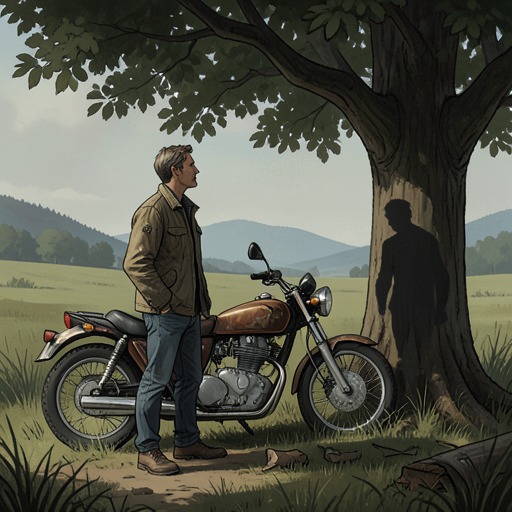
At their parting, Mpayipheli puts out his hand and thanks Koos. Koos answers with a broad, gap-toothed smile. Mpayipheli packs his bag into a side case, puts on his gloves, and starts the GS. This time he lets the engine warm, shifts through the gears, and settles behind the windscreen before accelerating. The difference from his first frightened ride on the powerful machine is plain: he is back in control. As Koos and the El Camino shrink behind him, their alliance ends, but the transport has restored his ability to continue north under his own power.